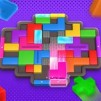
Block Slide challenges players to manage limited space by sliding colored blocks into place and setting up efficient row clears before the board fills up.
The One Mechanic Controlling Every Run
The entire game revolves around horizontal positioning and row clearing. The mechanics take less than a minute to figure out because the board only gives you one real action.
The Controls: You can only slide blocks left or right into empty grid spaces. You cannot rotate them, and you cannot drop them manually. That restriction is what makes spacing tough. In games like Block Dimension, you have a lot more ways to fix bad placements, but here you're stuck with whatever shape drops.
The Scoring Loop: Moving a block causes it to drop if there is empty space beneath it. The moment you complete a solid horizontal line across the board, that row clears out and your score ticks up.
The Defeat State: Every single slide that doesn’t result in a cleared line forces the entire board to shift upward by one layer. Your game ends the exact second any block hits the very top ceiling. And once the center gets blocked, the run usually collapses fast.
Escaping the 2,000-Point Wall
Most players hit a hard wall around the 2,000-point mark because that is when the game stops giving you clean, easy-to-use shapes. The board fills faster than expected, panic movements kick in, and you end up creating dead zones that are impossible to clear.
To keep the board clean, you have to change how you prioritize your slides.
Scan the Base Layer Outline First
The biggest mistake is only looking at the blocks that are already active. You need to train your eyes to focus on the very bottom of the grid, where the game displays a faint preview of the next layer about to rise.
If you see a massive, awkward gap shifting upward on the right side, you need to spend your current turn clearing a path directly above it. If you wait for that row to join the active board, you won't have the room left to slide your longer pieces into position. This is exactly where things get messy in games like Block Jam - one bad gap at the bottom quickly spirals into a crowded screen you can't clean up.
Never Let Long Blocks Sit in the Center
The 3-square and 4-square horizontal blocks are the primary reasons you lose control of a match. They act like lids, trapping smaller single pieces underneath them and cutting off your access to the lower grid.
Whenever a long block appears, clear it out immediately. It is much safer to hold onto your 1-square and 2-square pieces as emergency fillers rather than letting a giant block sit in the middle of your board for three turns. If you've played other tight grid titles like Simple Block Puzzle, you already know that letting big pieces clutter the center usually means a fast game over.
Set Up Chain Clears to Multiply Your Score
Clearing one isolated row at a time yields very few points and guarantees the board will constantly push upward. To get high scores, you have to intentionally let the grid stack up about three or four layers high to build a combo setup.
Position your pieces so that dropping one specific block triggers a chain reaction, clearing multiple rows in a single motion. This stops the upward board pressure instantly and triggers the combo multiplier, which is the only way to effectively scale your score before the shapes become too distorted to manage. Players coming from Wood Color Block will probably already recognize how important delayed combo clears can be once the board gets crowded.
Frequently Asked Questions
Is there a maximum score limit in Block Slide?
No, the game is infinite. However, the random shape generation algorithm becomes significantly more aggressive once you cross the 5,000-point mark, frequently spawning 4-square blocks that force fast defeats if your lower grid has open gaps.
What is the best way to recover when blocks reach the top warning line?
Stop trying to build high-scoring combos immediately. When you are one line away from a game over, your only goal is survival. Look for any single-line clear even if it yields low points to lower the board pressure and open up movement options.
Does the game speed up the longer you play?
Unlike Tetris, there is no falling speed that increases over time. The difficulty scale comes entirely from the complexity of the grid shapes and the height of the board. The pace of the game only moves as fast as you make your inputs.